WE-PDR counts the way you settle a claim: dents don’t start from zero for each panel — they add up across the whole vehicle, and the running total selects the price tier from the flat-rate table.
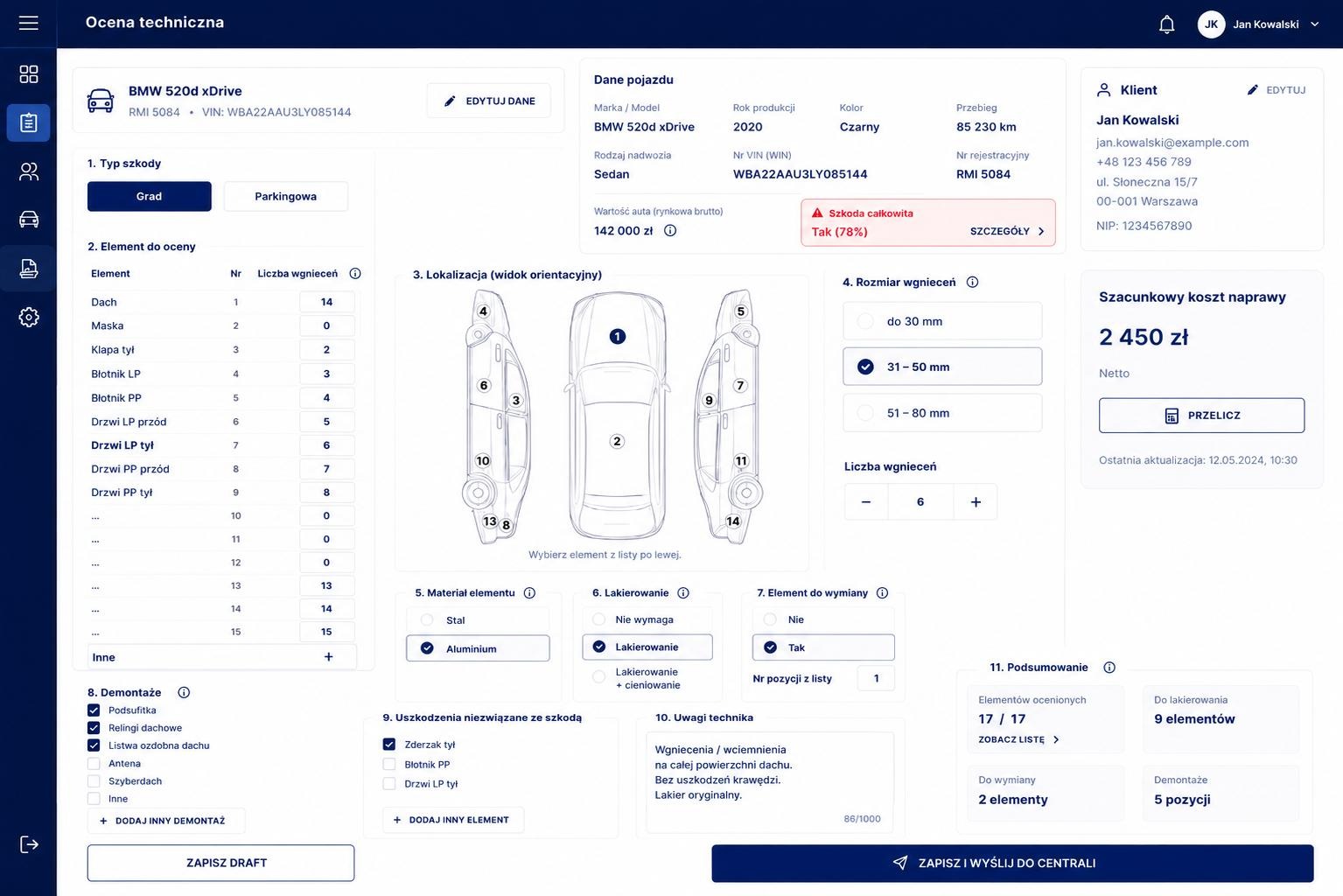
With the traditional "panel by panel from zero" approach, the same number of dents split across several panels yields a different price than on one panel. WE-PDR removes this: all dents up to 40 mm across the vehicle go into a single running total, which selects a tier from the flat-rate table (tiers in steps of 10).
Above 100 dents, each further dent adds +13.50 zł net. Larger dents (41–70 mm and over 70 mm) are billed with a separate per-dent surcharge, and material (aluminium) and painting modify the rate by clear rules. All amounts are net values from the global price list, editable per company.
Dents up to 40 mm add up globally — not per panel — and set the price tier.
The flat-rate table from 1–10 to 91–100 dents selects the right tier automatically.
For each dent above 100 the system adds 13.50 zł net.
Up to 40 mm — flat rate; 41–70 mm and over 70 mm — per-dent surcharge (different for steel and aluminium).
Aluminium and painting modify the rate by price-list rules, without changing the tier.
Global values can be overridden with the tenant’s own price list.
The system sums dents up to 40 mm from all panels of the vehicle.
The running total picks the correct tier from the flat-rate table.
Size, aluminium, painting and dents above 100 are added on top.
Panel-by-panel body assessment on a vehicle map with the estimate calculated live.
How it works →Repair cost as a share of vehicle value with a colour alarm and a 70% threshold.
How it works →Compares the PDR repair cost with panel replacement — for each panel separately.
How it works →Create an account and walk the whole path: from inspection, through the estimate, to a finished PDF document.